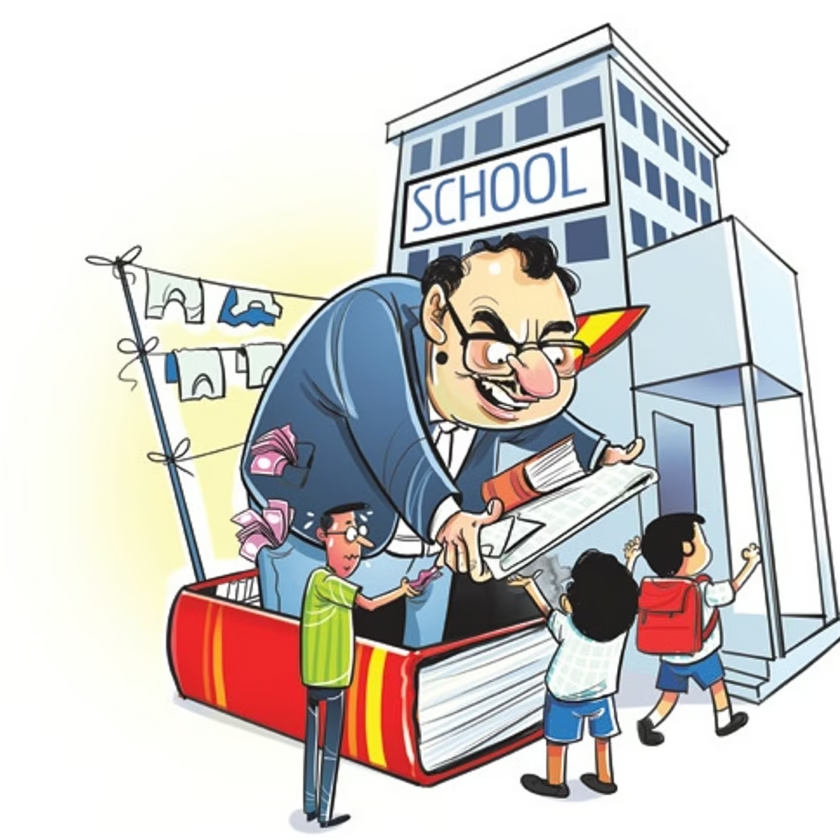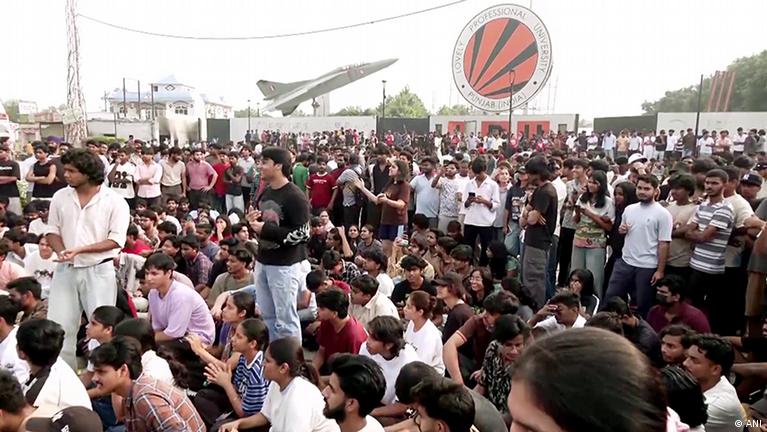
The controversy involving Kashmir-origin student influencer Farhat Dev is still under investigation. But the larger lesson is already clear: one unverified claim, one emotional reaction and one reckless decision can put a student’s education, reputation and future at risk.
By: Javid Amin | 29 Aug 2026
Srinagar: A university campus is supposed to be a place where young people learn, question, debate and prepare themselves for the future.
It should not become a place where rumours replace facts, anger replaces judgment and a protest turns into vandalism.
The recent unrest at Lovely Professional University (LPU) in Punjab offers a difficult but important lesson for students across Jammu and Kashmir, particularly those leaving home for colleges and universities outside the Union Territory.
The controversy began after claims circulated on social media alleging that a female student had been sexually assaulted on campus. Students protested, demanding action and answers.
But the situation later escalated into violence, vandalism, arson, clashes and damage to university property. Police registered a case and constituted a Special Investigation Team, while the university initiated disciplinary proceedings. Authorities have said that they had not found evidence substantiating the sexual-assault claim that triggered the unrest.
Around 30 to 40 students are reportedly under scrutiny as CCTV footage and other evidence are examined.
Among the people whose role has come under public discussion is Farhat Dev, described in several reports as a Kashmir-origin student and social-media influencer known for poetry and rap.
But an important distinction must be maintained.
Farhat Dev has denied involvement in vandalism, and the allegations against him have not been independently established. His role remains under investigation.
That uncertainty is precisely why the episode should not become a story of blaming one individual.
It should become a lesson for students.
The first lesson: Never turn a social-media claim into a fact
The most disturbing part of the LPU episode is not only the violence.
It is how quickly information appears to have travelled before being established.
A claim concerning the safety of a female student generated anger among students. The issue moved rapidly through social media and word of mouth, eventually contributing to protests that escalated into serious disorder. Police subsequently said they had not found evidence substantiating the alleged sexual assault.
This is exactly the environment in which students need to be most careful.
A WhatsApp message is not evidence.
An Instagram story is not evidence.
A viral video is not necessarily evidence.
A friend’s claim is not evidence.
Even a video can be misleading if it is edited, taken out of context or incorrectly captioned.
The LPU episode provides another warning: India Today reported that a deepfake video falsely portrayed a police officer as linking the alleged accused to a political party and a senior politician. The original video did not contain that statement.
If students can be shown a fabricated video of a police officer making a statement that he never made, how easily can an ordinary student be misled by other viral content?
That is the question every young person should ask.
Second lesson: Anger is understandable. Violence is not the answer.
Students have every right to raise genuine concerns.
If a student believes that a woman is unsafe, the response should be serious.
If an institution has failed to address a complaint, students can demand answers.
If there is evidence of wrongdoing, students can approach:
- university authorities,
- police,
- women’s safety committees,
- legal authorities,
- student grievance mechanisms,
- courts,
- recognised student organisations,
- or other lawful forums.
A peaceful protest is fundamentally different from destroying property.
Once a protest turns into arson, stone-pelting, looting or vandalism, the original issue can become secondary.
The LPU unrest reportedly included damage to university property, looting and clashes after the initial protests.
Students should understand one simple principle:
You can demand justice without destroying the institution in which you are studying.
Third lesson: Your university is not just a building
This is particularly important for students from Jammu and Kashmir studying outside the UT.
For many families, sending a child to another state is a major financial and emotional investment.
Parents borrow money.
Families use savings.
Students spend years preparing for admission.
A university is therefore not merely a campus.
It is a student’s:
- degree,
- academic record,
- professional network,
- reputation,
- career pathway,
- and often the biggest investment their family has made in their future.
When a student becomes involved in campus violence, the consequences may not end when the protest ends.
There can be disciplinary proceedings, suspension, expulsion, police investigation, legal proceedings, academic disruption and reputational consequences.
Even if a student did not commit the central offence, being present at a violent incident can lead to questioning or investigation.
The safest approach is therefore not to become part of a crowd whose actions you cannot control.
For Kashmir students, there is another responsibility
A student from J&K does not become responsible for the behaviour of every Kashmiri student.
Nor should an individual incident be used to stereotype an entire community.
That principle must be maintained.
At the same time, students from J&K studying in other parts of India should recognise that their conduct can sometimes receive disproportionate attention because of the region’s complicated social and political history.
This is not a reason for Kashmiri students to remain silent.
It is a reason to be more careful, more informed and more disciplined.
A student from Kishtwar, Srinagar, Anantnag, Baramulla, Jammu or any other part of J&K represents only himself or herself.
But every responsible student also carries the hopes of a family that has sent them away to study.
That responsibility should never be forgotten.
Being a Muslim student makes the lesson even more important
This point needs to be approached carefully.
The issue is not that Muslim students are uniquely responsible for what happened.
They are not.
Violence, misinformation and mob behaviour are not characteristics of any religion or community.
But for a Muslim student, there is an additional ethical framework that can serve as a powerful reminder:
Do not act on information before establishing its truth.
The Qur’an explicitly warns believers to verify information before acting on it when a report comes from an unreliable source.
The principle is often summarised through the command to verify news before causing harm to people through ignorance and later regretting one’s actions (Qur’an 49:6).
That principle has extraordinary relevance in the age of social media.
A Muslim student does not need to choose between compassion and caution.
The two can exist together.
You can be deeply concerned about a woman’s safety.
You can condemn sexual violence.
You can demand an investigation.
You can stand with a potential victim.
And you can still wait for facts before accusing someone or joining a violent crowd.
In fact, those responsibilities should go together.
Islam does not require blind following
There is another important lesson for young Muslim students.
Being emotionally moved by a speaker, influencer or social-media personality does not mean accepting everything that person says.
The internet has created a new form of influence.
A person does not need to be a professor, lawyer, journalist or community leader to influence thousands of young people.
A microphone, a camera and a large following can be enough.
Poetry can influence.
Rap can influence.
Instagram can influence.
YouTube can influence.
Short videos can influence.
A charismatic student can influence.
But influence is not evidence.
A person may be sincere and still be wrong.
A person may be angry and still be misinformed.
A person may believe a rumour and sincerely spread it without knowing that it is false.
Students therefore need an intellectual habit that is more powerful than social-media loyalty:
Think before you follow.
Do not confuse a viral video with the whole truth
The Farhat Dev controversy demonstrates another modern problem.
Videos can show that a person was present.
They do not automatically establish what that person did before or after the recording.
A short clip may show an argument without showing what caused it.
A person entering a room does not by itself establish that the person destroyed something inside it.
A person standing near a protest does not automatically establish responsibility for every act committed by the crowd.
This is why investigations use:
- CCTV,
- multiple camera angles,
- witness statements,
- phone records,
- forensic evidence,
- digital evidence,
- timelines,
- and other material.
In the LPU case, authorities are reviewing CCTV and other evidence, while the university has set up a disciplinary committee to examine alleged involvement in the violence.
Students should learn from that process.
Do not convict someone in your head because you saw a 20-second video.
And equally:
Do not defend someone blindly because he belongs to your region, community, university or friend circle.
Let evidence decide.
The biggest danger is the crowd
A student may never personally intend to damage property.
But crowds can change individual behaviour.
One person throws something.
Another starts shouting.
Someone breaks a window.
Another person begins recording it.
Others join.
Within minutes, people who came to protest peacefully can find themselves inside a violent situation.
The individual may then say:
“I didn’t start it.”
That may not prevent questions about what happened next.
This is why students need to recognise the moment when a protest is becoming unsafe.
When a peaceful demonstration begins turning into:
- stone-pelting,
- property destruction,
- fire,
- forced entry,
- looting,
- threats,
- physical attacks,
leave.
Do not stay because friends are staying.
Do not stay because everyone else is doing it.
Do not stay because someone on Instagram says it is necessary.
Your degree is more important than proving your courage to a crowd.
Your phone can protect you, but it can also destroy you
Today’s students carry a powerful device in their pocket.
The same phone can:
- call the police,
- record evidence,
- contact university authorities,
- document misconduct,
- alert parents,
- seek medical assistance,
or it can:
- spread rumours,
- amplify fake claims,
- publish someone’s private information,
- encourage a mob,
- circulate manipulated videos.
Before forwarding anything, ask three questions:
1. Who originally posted this?
2. Has an independent source confirmed it?
3. What could happen if this information is false?
If the answer to the third question is “someone could be harmed”, don’t forward it until it is verified.
Don’t let someone else’s agenda become your criminal liability
This may be the most practical lesson for students.
Sometimes people enter a protest because they genuinely care.
Sometimes they join because friends are there.
Sometimes they join because a social-media personality tells them to.
Sometimes they have no idea who organised the gathering.
But if violence follows, the person who encouraged the crowd may not necessarily be standing beside every student when consequences arrive.
The student, however, may still face the consequences of his or her own actions.
That is why students should always ask:
Who is asking me to do this?
What exactly am I being asked to do?
Is it legal?
What happens if things become violent?
Will this help the person whose cause I am supporting?
If the answer is unclear, step away.
There is a difference between courage and recklessness
Young people naturally want to stand up for what they believe is right.
That is a positive quality.
But courage does not mean acting without information.
Real courage can mean saying:
“I don’t know whether this claim is true yet.”
It can mean telling friends:
“Let’s wait for the police or university to confirm it.”
It can mean leaving when the crowd becomes violent.
It can mean refusing to break something even when everyone around you is doing it.
And it can mean disagreeing with your own friends.
That is not weakness.
That is self-control.
What should a Kashmiri student do if a serious allegation emerges on campus?
The answer should be simple.
Step 1: Take the allegation seriously
Never dismiss a genuine complaint of sexual harassment or violence.
Step 2: Do not spread unverified details
Protect the privacy of the alleged victim and avoid publishing names, photographs or personal information.
Step 3: Inform the proper authority
Approach university authorities, police or the relevant grievance mechanism.
Step 4: Demand investigation, not punishment without evidence
The purpose of an investigation is to establish what happened.
Step 5: Protest peacefully if necessary
Students have legitimate ways to raise collective concerns.
Step 6: Leave if violence begins
Do not allow someone else’s actions to drag you into criminal or disciplinary trouble.
Step 7: Preserve evidence
If you genuinely witness something important, preserve the original recording and provide it to investigators rather than turning it into social-media entertainment.
A lesson particularly important for Muslim students from J&K
There is nothing wrong with being emotionally concerned about injustice.
There is nothing wrong with standing up for women.
There is nothing wrong with demanding accountability from a university.
There is nothing wrong with peaceful protest.
But there is a serious problem when emotion becomes a substitute for verification.
For a Muslim student, the ethical principle of verifying information before acting should be treated not as an abstract religious teaching but as a practical rule for the digital age.
Verify before forwarding.
Investigate before accusing.
Think before following.
Walk away before violence begins.
Protect your education.
Protect your family’s investment in you.
Protect your own future.
Your parents did not send you away to become part of a mob
For many Kashmiri families, sending a son or daughter to a university outside J&K requires enormous sacrifice.
Parents often worry about:
- safety,
- accommodation,
- finances,
- academic performance,
- social environment,
- discrimination,
- mental pressure,
- and the child’s future.
When a student gets involved in an unnecessary confrontation, the consequences are felt far beyond the campus.
A parent who expected a degree may suddenly have to deal with a police inquiry.
A family saving for education may have to deal with legal expenses.
A student preparing for a career may suddenly face disciplinary proceedings.
All because of something that may have started with a message on a phone.
That is an enormous price to pay for failing to pause for a few minutes and verify information.
The Farhat Dev controversy should not become another social-media trial
There is also a lesson for people discussing Farhat Dev himself.
He has denied the allegations.
Reports say the university is investigating his role, and the allegations have not been independently established.
Therefore, students should not declare him guilty or innocent based merely on viral clips.
The proper question is:
What does the evidence eventually establish?
Until then, responsible discussion requires restraint.
This is important because the same principle that protects an accused person from an unfair social-media trial also protects students from being manipulated by misinformation.
The bigger warning from LPU
The LPU episode reportedly began with an allegation that demanded serious attention.
But somewhere between the allegation, social media, protest, crowd emotion and violence, the central objective of establishing facts became increasingly difficult.
That is exactly what students must avoid.
A campus should be a place where facts are investigated, grievances are heard and institutions are held accountable.
It should never become a place where the loudest rumour determines what happens next.
For students from J&K, and particularly young people who are Muslim and studying away from home, the lesson is not to remain silent.
It is to become more responsible voices.
Stand for justice.
But verify the claim.
Stand for women’s safety.
But protect due process.
Raise your voice.
But don’t destroy property.
Join a peaceful protest.
But leave when it turns violent.
Support your friend.
But don’t defend wrongdoing blindly.
Listen to an influencer.
But never surrender your own judgment.
The lesson every student should remember
A degree can take years to earn.
A reputation can take years to build.
A family’s savings can take years to accumulate.
But a rumour can spread in minutes.
A violent incident can happen in minutes.
A video can go viral in minutes.
And one reckless decision can follow a student for years.
The LPU controversy is still being investigated, and responsibility for specific acts should be determined through evidence and due process. But the broader lesson does not require waiting for the final investigation.
Students should never allow an unverified social-media claim to make decisions for them.
For a young person from J&K studying outside the region, the safest formula is simple:
Verify the information.
Use lawful channels.
Protest peacefully.
Reject violence.
Do not follow crowds blindly.
Protect your education and your future.
Because when the crowd goes home, when the cameras disappear and when the social-media trend ends, the student is left to live with the consequences.
And no viral post is worth losing the future your family worked so hard to build for you.